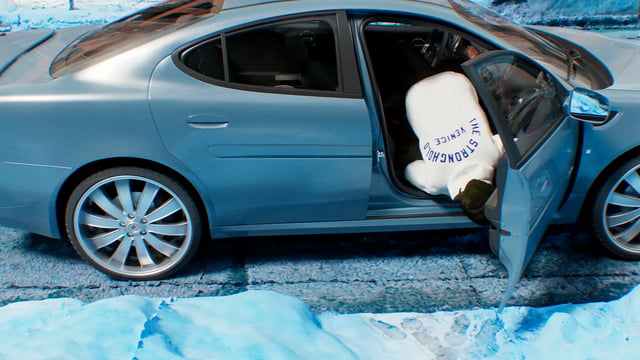
Forensic animator Shawn Kinsey of 4ensic IMPACT used Xsens Link to recreate a suspect’s movements inside a matching car, turning a question the cameras could not answer into recorded human motion for a high-stakes legal case.
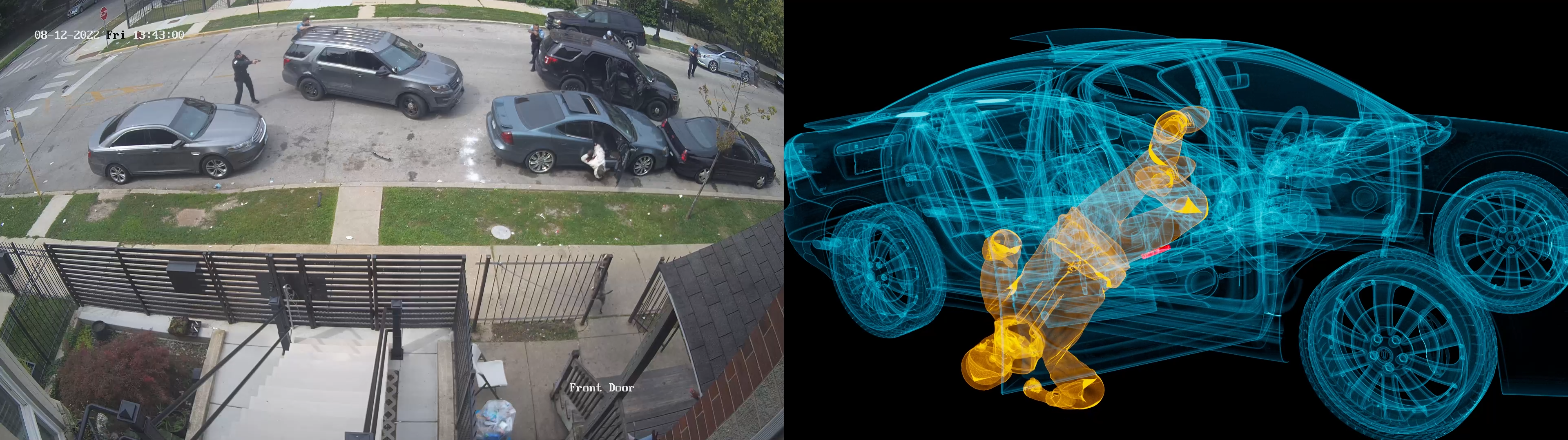
Security camera footage of the scene, alongside the X-ray reconstruction of the movement inside the car.
Some movements have to be performed to be understood.
For a police shooting case, Shawn Kinsey needed to know how a pistol had ended up on a car’s passenger seat. No camera had seen it happen. So the founder of 4ensic IMPACT used a car of the same make, model, and year, climbed inside in an Xsens Link suit, and acted out the possibilities with a weighted replica pistol, while the legal team and experts on the case watched live.
It was the second of two questions in the case, and the answer had to hold up in court. That meant the movement behind it had to be real.
Turning technical evidence into something people can follow
 Shawn’s background in architecture shapes the way he approaches a scene. He studied at Georgia Tech, then moved into 3D visualization for engineering projects before turning to forensic work. The ability to build accurate environments carried over naturally to crime scenes, crashes, and questions about visibility.
He started his own company, 4ensic IMPACT, to work directly with clients and make a meaningful difference in their lives. “It’s a good feeling when you help people,” he says.
His job is to make technical evidence easier to follow. Reports, testimony, and measurements provide the foundation. His visuals help people understand what that information means. As he puts it, “I am exercising brevity and clarity and keeping it as simple as possible.”
Much of his toolset will be familiar to animators in games, film, and VFX: scanned environments, matched cameras, rigged characters, lighting, and animation. The difference is the room for interpretation. Framing and visual cues can help explain a scene, but the incident itself has to remain accurate and reliable.
Two questions the cameras could not answer
Shawn was approached by legal counsel for the defense, representing a police Department in a civil lawsuit against the city. Police had seen a man put a pistol behind his back before he got into a parked car. When officers arrived, one of the responding officers said he saw the man draw a firearm and subsequently fired his own weapon.
A pole camera, a nearby home security camera, and the officer’s body camera all recorded the incident. None showed what the officer saw. The body camera was mounted just above his waist, well below his eyes. The partly open driver’s door blocked its view into the car, and dark window tint limited the other angles.
“There were two main questions the recordings couldn’t answer on their own,” Shawn says.
The first, and the main objective, was what the officer could have seen. The second was how the pistol, last seen tucked behind the man’s back, ended up on the passenger seat.
Rebuilding the officer’s point of view
Shawn began at the scene. He laser-scanned it, flew a drone with RTK positioning, and took ground-based overlapping photos for a photogrammetry model, which he checked against the laser scans. At the police impound lot, he scanned and photographed the car inside and out.
Next came videogrammetry: measuring from video to find each camera’s position, focal length, and lens distortion. “It was difficult,” he says. “I mean, normally on cases, I get one camera to do videogrammetry analysis. In this case, I had three.” Once the 3D scene was aligned with the footage, he could accurately position the vehicle, determine the angle of the open door, and track the officer’s movements, particularly his head and eye position, to help establish what was within his field of view.
Shawn then placed a virtual camera with a 50 mm lens at the point between the officer's eyes; a focal length that human factors experts accept as the closest match to human vision. To test the margin for error, he moved the camera about four inches (10 cm) up, down, and to each side. Almost every position gave the same answer.
“Now, we don’t know, and we’ll never know for certain, whether the suspect actually pulled a gun. But what we proved was that the responding officer was in a position where, if the suspect had drawn his firearm as the officer described, he would have been able to see it. And that’s all I can definitively say.”
The second question could not be answered from the footage. Someone had to perform it.
Capturing movement inside a closed car with Xsens
Shawn had used Xsens Awinda on earlier cases. In one, a railroad worker was crushed while trying to stop a rolling tank car with a defective brake. In another, a painter fell from scaffolding after a safety clip failed. Both were captured in open spaces with props Shawn built himself.
The police shooting case was different. He would be twisting over a center console, crawling across a seat, pushing a door open, and falling out of a car.
A camera-based motion capture system would have struggled there. Shawn had seen its limits years earlier, when arms got lost or crossed up whenever the cameras could not see them. "And so there were real limits with using those visual-based systems." Inside a car, seats, doors, and a center console block the view. Xsens Awinda and Xsens Link both avoid that problem. As inertial systems, neither one depends on a clear camera view. "This particular use case was being able to be inside a car, a closed car, and record data," Shawn says.
The choice between the two came down to the movement. Xsens Awinda uses wireless sensors on adjustable straps, so it is quick to set up and can be worn over regular clothing. Xsens Link places its sensors in a close-fitting suit and captures at a higher update rate. For this case, Shawn chose Xsens Link.
"Because I knew I was going to be inside a car, and the stakes were higher, I felt the data would be more reliable with the Link suit. It keeps the sensors securely in place, even when you’re twisting and turning, which is especially important for capturing faster, more complex movements accurately.”
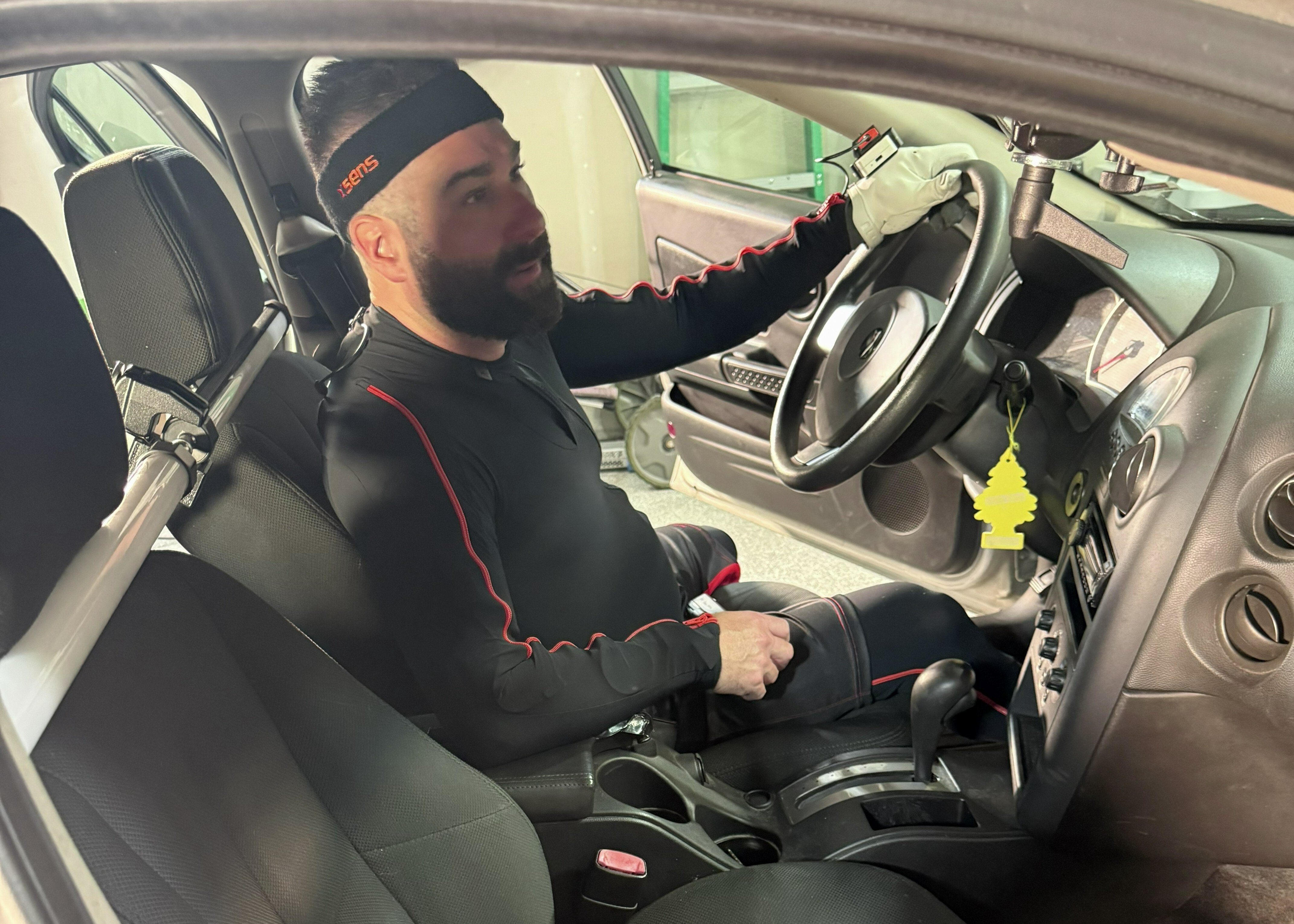
Inside the matching car: Shawn Kinsey in Xsens Link before a capture for the police shooting case.
Testing the pistol’s path in a matching car
Going in, Shawn did not know how the pistol had reached the passenger seat. That open question is what he enjoys most about this work. "These are the cases I really like, where you're a detective," he says.
He set up the matching car in his garage and used the weighted replica pistol to test several possible movements. Keeping it on his lap while moving across the seat did not work well. He also tried a sudden movement of his hips, as if reacting to being shot, to see whether that could throw the pistol across.
The version that fit best was holding the replica in his hand while crawling over the console and out of the passenger side. In Shawn’s assessment, the test supported that as a likely way the pistol could have reached the seat. It did not prove exactly what happened during the incident.
He split the capture into sections: the officer’s stance, the man seated in the car, drawing the pistol from behind his back, and moving across the interior. The longest section included opening the passenger door, falling onto his shoulders and back, and twisting out. A T-pose, with his arms extended sideways, marked the start and end of each section so it was easy to find later.
A colleague ran the recording software on a laptop while the attorneys, the officer, the biomechanics expert, and the firearms expert watched four live camera views. The colleague checked each take for tracking problems and replayed it on a simple 3D character. That playback showed the body movement, although it did not yet include the car or props.
The officer also guided Shawn’s stance and firearm grip during the session. With that direction and the incident video as reference, the recorded poses gave Shawn a strong starting point for animation. “It was 85% there,” he says.
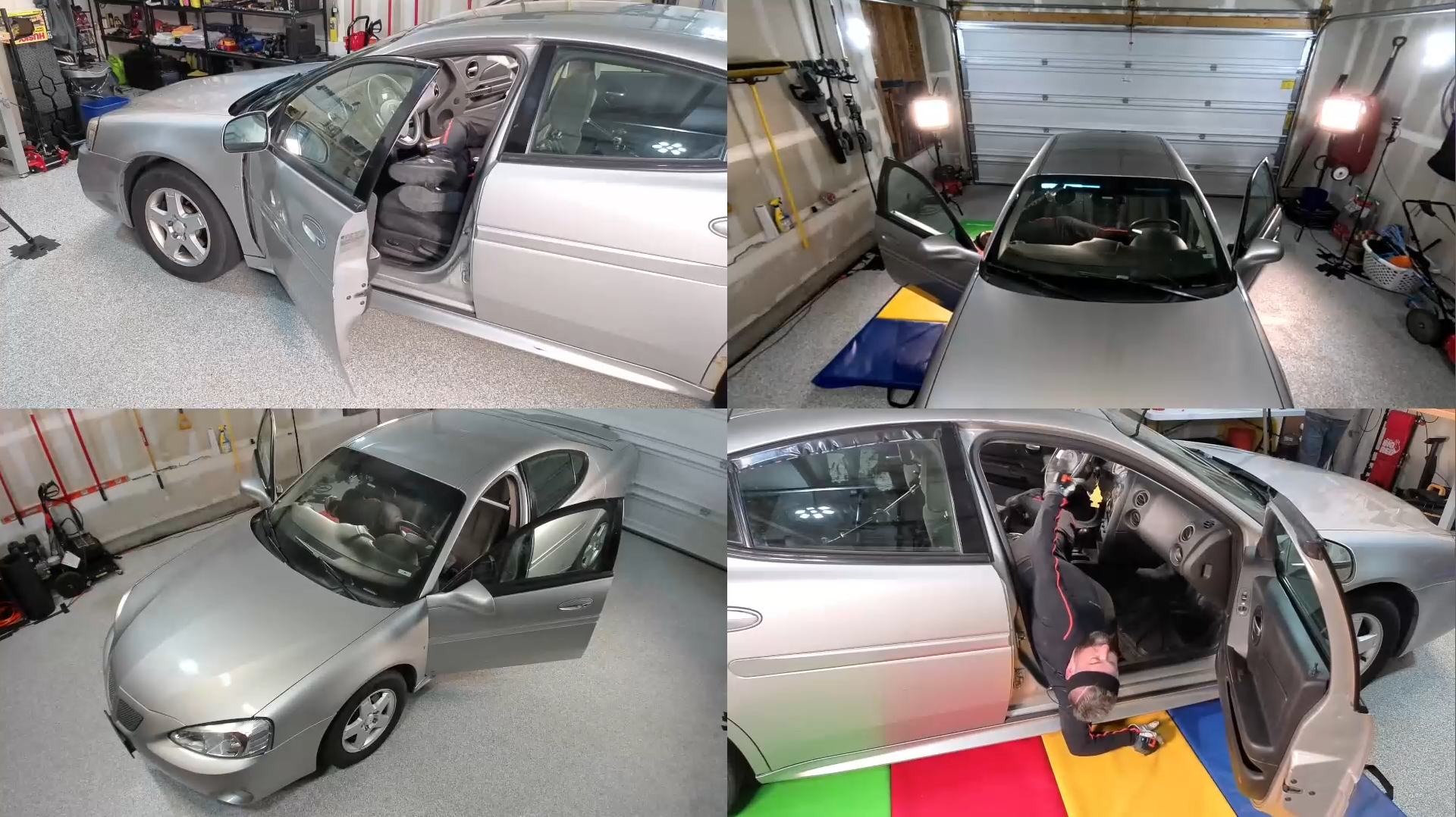
The full capture session, recorded from four synchronized camera angles.
Retargeting and retiming in 3ds Max
Shawn processed the recordings in Xsens Animate and exported them as BVH into 3ds Max, onto a custom character he had rigged with the biped system. A character file kept the proportions of the man in the car, who was several inches taller than Shawn, so the joint angles held up through retargeting.
Because the exemplar car matched the scanned car, his movements already fit the digital interior. He added small adjustment layers where fingers or feet touched geometry, keyed the arm and leg that stayed outside the door, and added the hand that reaches up through the sunroof. He also refined the movement so the character interacted correctly with the scanned geometry of the curb, roadway, and grassy median around the car.
The cleanup was the part that stood out. “This data was really clean,” Shawn says. “I had little if any cleanup to do on that, it just came in right.”
His performance was a little faster than the real event, so he retimed it to match the footage. Acting a split-second event to the exact frame was never realistic, but “the dynamics of the motion were really close,” he says. With the biomechanics expert, the logic was simple: a movement that can be done faster can also be done slower.
The finished reconstruction brought both questions together: the officer’s line of sight from the solved cameras, and an animated sequence of the man’s movement built on Shawn’s recorded performance.
A photorealistic motion capture render of the reconstruction, showing the retargeted character in the scene with the car and lighting.
Matching the system to the movement
On the police shooting capture, Shawn's colleague never had to stop a take for a tracking problem. "We didn't have to do any of that," Shawn says.
On earlier cases, Shawn used Xsens Awinda, where the sensors sit on adjustable straps worn over regular clothing. Shawn puts the difference down to that setup. In his view, during complex movement in a tight space, such as twisting and crawling across a car, a sensor on a strap can shift slightly. The close-fitting Xsens Link suit keeps the sensors in place during that kind of motion. Xsens Link also captures at up to 240 Hz, compared with 60 Hz for Xsens Awinda, which gives more samples during fast movement.
He sees a place for both. Xsens Awinda is quick to set up, which suits sessions that need to come together fast. For complex movement in tight spaces, Xsens Link is his preference.
Motion capture data that went unchallenged before trial
Before trial, Shawn and the biomechanics expert looked at Xsens’ published accuracy information. The expert, who knew motion capture from sports medicine research, was confident in the range of motion and joint angles the data showed.
The opposing side asked the court to exclude his work, arguing that its methods were not grounded in accepted science. Its focus was the camera placement and videogrammetry. Shawn wrote a rebuttal report and overcame the challenge. The motion capture data was not disputed.
For Shawn, that is the difference between capturing movement and inventing it. Keyframe animation on its own cannot show that a movement is physically possible. “In my experience, you can make up anything in the computer. There's no bounds or limits.” A recorded performance carries the limits of a real body.
The case ended in a confidential settlement, and the defense was happy with the outcome.
The finished X-ray animation, matching the man’s movement to the parts visible in the recorded video.
What smaller teams can take from it
Courtrooms are a long way from game studios and film sets, but Shawn’s production problem will sound familiar. “We’re all generalists,” he says. "We do everything from modeling, texturing, physics to lighting."
In a small team, character animation is often the hardest part to get right. For most of Shawn’s career, the moments leading up to an injury were shown as three or four still boards, because animating the movement in between was beyond the time and resources available. Motion capture let him show the movement itself. Indie studios and small game and film teams face the same trade-off with cinematics, stunts, and character performance.
His workflow also offers a few practical lessons:
- Choose the system for the shot. Xsens Awinda is quick to set up and makes it easy to switch between performers. Xsens Link is the better fit for stunts, fights, falls, and close-quarters action, where the sensors need to stay firmly in place.
- Build props to match the digital set. Shawn’s exemplar car matched his scan, so contact fixes came down to small adjustment layers. A physical stand-in built to the dimensions of a game level or film set reduces intersection cleanup after retargeting in the same way.
- Split complex action into segments. A clear pose between takes makes each one easy to find and assemble, which helps when a scene is built from many short pieces.
- Put decision-makers on the live feed. The officer could guide the performance, and the experts could watch it in real time. A director or lead animator can do the same and catch problems before the session ends.
- Expect to retime, not rebuild. If the dynamics are right, timing can be matched to reference later.
Performing the action also tests the assumptions around it. On the train-yard case, Shawn built a full-scale replica of the end of a tank car and found that the procedure a safety expert recommended was impractical in reality. For game and film teams, the same applies in previs: acting out a climb, a vehicle exit, or a fight beat shows what a body can actually do before the animation is locked.
Next for 4ensic IMPACT
Shawn sees more room for motion capture in personal injury cases, where the way someone moved matters, and in showing how workers handle tools and equipment. Extreme physics, such as a rider thrown from a motorcycle, will still need simulation. Movements a person can perform safely are where he sees capture adding the most.
He also plans to move to the next-generation Xsens Link, and he is looking forward to it. Its faster setup means less time preparing and more time capturing, which matters for a small team like his. Whatever the tools, his approach to each case stays the same: “you don’t know until you start testing.”
Planning a capture with fast, close-quarters movement, or a take you cannot afford to redo?
See how Xsens Link helps small teams record real performance with less cleanup.


