Transforming Flight Training and Fleet Safety through High-Fidelity Data
INTUOS, founded in 2019, is redefining how general aviation and ultra-light aircraft operators, flight schools, and fleet managers monitor and manage their flights. As CEO Carolina Gianardi summarizes:
“Our mission is to help customers digitize their processes, increase safety, and improve operational efficiency.”
What originated as an operations platform for aviation companies has evolved into a seamless, real-time flight data monitoring ecosystem capable of turning any analogue aircraft into a fully digital, telemetry-rich asset.
At the heart of this transformation lies INTUOS’s proprietary Inflight Unit (IFU), paired with the ultra-compact Xsens MTi-3 Series sensor module. By leveraging Xsens’s industry-leading inertial sensor technology, INTUOS delivers high-precision motion and attitude data that unlocks unparalleled insight into flight performance, safety, and pilot training.
Industry Challenge: Analog Aircraft, Missing Data and Limited Insights
Most of the general aviation and ultralight aircraft still rely on analog instrumentation. While pilots see airspeed, altitude, and attitude during flight, none of it is recorded. Once the aircraft lands, the information is gone.
Digital aircraft offer more capability, but even then operators typically need to manually download SD cards and process data offline, a time-consuming task used only after incidents, not proactively. Traditional GPS trackers provide location and speed, but not the accurate attitude or manoeuvre data needed to meaningfully analyze flight behaviour.
INTUOS’s goal was to bring airline-grade flight data monitoring to general aviation, but in a plug-and-play, cost-effective package suited for flight schools and small fleet operators.
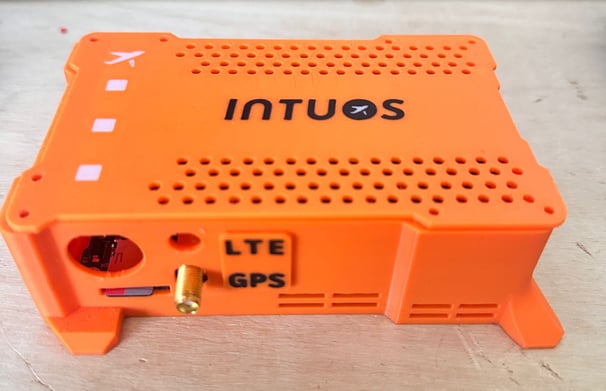
A proprietary plug-and-play, smart system that collects and transmits real-time flight data with the MTi-3.
The INTUOS Solution: A Real-Time Telemetry Platform for any Aircraft
To close the data gap, INTUOS developed the Inflight Unit (IFU): a 220-gram plug-and-play telemetry module that installs in minutes and streams flight data every two seconds. Some highlights of the IFU are:
-
Real-time transmission via 4G, with auto-switch satellite backup
-
Full telemetry capture including GPS, altitude, attitude (pitch/roll/yaw), G-forces, and environmental data
-
Automatic flight log creation, no downloads required
-
Fleet-wide visibility via an intuitive cloud dashboard
-
Post-flight replay in detailed 3D visualization
-
Safety dashboards with pilot-level analytics and event detection
INTUOS’s software platform ties these elements together, turning raw flight data into visual dashboards, risk alerts, and actionable performance insights.
But for the system to work, INTUOS needed highly accurate, drift-free attitude data. And this is where they hit a wall.
Technical Roadblocks: Drift, Sensor Failure, and the Limits of Low-Cost IMUs
Before partnering with Xsens, INTUOS spent significant engineering effort evaluating IMUs. None were reliable.
Vito Tedeschi, INTUOS’s CTO, describes the process as followed:
“It was a nightmare. We tried multiple sensors. With some chips, pitch and roll drifted by one degree per second. Others overwhelmed our processor with the fusion algorithms needed. None were accurate or stable enough.”
The challenges included:
-
Sensor drift, making orientation unreliable within seconds
-
Poor roll/pitch stability, unusable for manoeuvre detection
-
Inconsistent data, especially under turbulence or fast manoeuvres
The IFU could not be released until a robust, aviation-grade AHRS was integrated. The system’s entire value depended on stable, trustworthy attitude data.
That reliability came with the introduction of the Xsens MTi-3 Series.
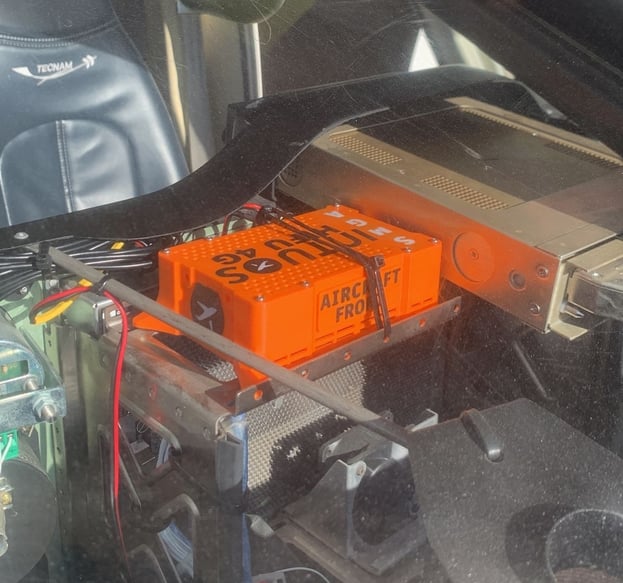
The INTUOS Inflight Unit (IFU) plugged into a helicopter
Why Xsens MTi was the perfect fit:
-
Drift-free orientation, essential for training and safety monitoring.
-
High-frequency data, suitable for capturing dynamic flight behavior.
-
Embedded sensor fusion, reducing CPU load on the IFU.
-
Tiny form factor, fitting easily under shielding inside the enclosure.
-
Reliable performance, even in challenging magnetic environments.
Impact: Real-Time Safety, Better Pilot Training, and Prevented Incidents
With the MTi-enabled IFU deployed, INTUOS customers began experiencing immediate benefits.
-
Improved Situational Awareness: Fleet operators can now view live flight data from anywhere. They receive instant warnings if bank angles, G-loads, or other parameters exceed safe thresholds.
-
Higher Training Quality: Instructors use detailed 3D playback to show students exactly where they deviated from proper technique.
-
Visual Manoeuvres Detection & Analytics: Machine learning identifies manoeuvres, flight envelope exceedances, and pilot behaviour patterns, something impossible without accurate attitude data.
One incident illustrates the power of INTUOS’s system. A student pilot veered off the runway during landing, temporarily closing an international airport. The operator immediately replayed the flight and discovered a sudden wind gust had lifted one wing, this is crucial information for diagnosing the event and training the student.
In another case, data revealed a pilot repeatedly flying at unsafe speeds, leading the operator to intervene before an accident could occur.
As Carolina explains:
“We bring value because our customers can understand what happened. Immediately, objectively, and with the data to support it.”
Conclusion
INTUOS set out to democratize flight data monitoring for general aviation. With the Xsens MTi at the heart of its Inflight Unit, the company achieved the accuracy and reliability needed to make real-time flight intelligence accessible, affordable, and impactful.
Today, INTUOS is enabling:
-
Safer pilot training
-
Better fleet oversight
-
Objective, data-driven debriefing
-
Automated safety analytics
-
A new standard of digital transparency in general aviation
Paired with Xsens technology, flight data is transformed from simple recordings into continuous learning opportunities. By enabling reliable sensor integration, Xsens provides a scalable foundation for advanced analytics, immersive training environments, and future-ready safety solutions. As these capabilities continue to evolve toward predictive insights and VR-based training, Xsens technology plays an increasingly important role in shaping the future of flight training and fleet safety.
A special thanks to Lunitek for their valuable support in bringing this customer case together.