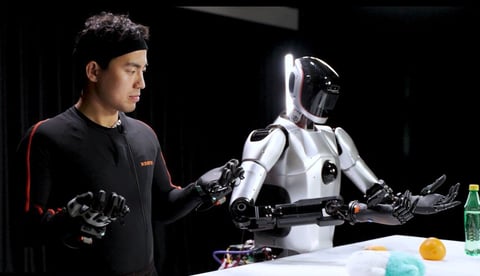
Humanoid robots are attracting enormous attention, but one of the biggest challenges is not simply building the robot. It is teaching that robot how to operate reliably in the real world.
Dennis Kloppenburg, Innovation, Growth & Business Manager at Xsens Technologies, recently spoke with InnovatieNU, a journal by the University of Twente, about what Xsens has learned from working with robotics developers and what manufacturers can do today to prepare for Physical AI.
In this blog, we publish a summary of the article. Read the full interview in the PDF.
The real challenge is the data
Robot hardware is developing quickly. But useful robotic skills depend on having enough high-quality, varied training data. A robot may learn a task successfully in a lab, but that does not mean it will perform reliably in a factory or warehouse. Changes in the environment, objects, or the way a task is performed can all affect the result. That is why Dennis highlights the importance of collecting data in the environment where the robot will eventually operate.
More data is not always better
Successful robotics projects also need a structured approach to data. Dennis describes it as a balance between four things: quantity, variation, quality, and context.
Collecting large amounts of poorly structured data is not enough. Teams also need to think about labeling, annotation, storage, and how the data can be reused.
Think about data ownership
As robot manufacturers begin offering data collection and training services, companies also need to consider who owns the resulting data. Manufacturers can rely on a specific robot vendor, or build a more independent data collection workflow that can potentially support different robots, tasks, and platforms.
For companies planning to use robotics at scale, that data may become a valuable long-term asset.
Start preparing before the robots arrive
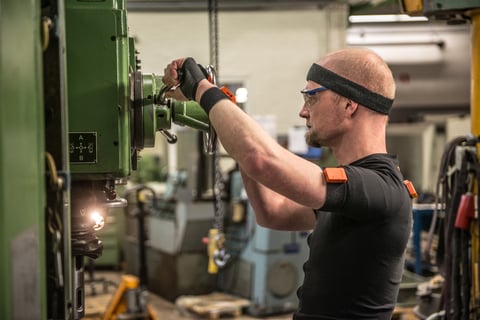
Dennis's main advice is not to wait until humanoid robots are ready for large-scale deployment. Manufacturers can already start digitizing their workplaces and processes, capturing how people perform tasks and building the data infrastructure that future robotic systems will need.
Early robot deployments should also be seen as an opportunity to learn: understand which tasks are suitable, what data is required and how the technology fits into existing operations.
Building the foundation for Physical AI
The future of humanoid robotics will depend on more than better hardware. It will also depend on the quality of the data used to train intelligent systems. By starting to capture and structure human work today, manufacturers can build the foundation they will need when robotics technology is ready to scale.
Learn more about Xsens for Humanoid Robotics.