High-quality gait research depends on high-quality data. Whether investigating clinical populations, athletic performance, or rehabilitation outcomes, researchers require accurate, repeatable motion data that can be consistently captured across sessions, participants, and research sites. Motion capture has become an essential methodology in gait research because it provides detailed full-body kinematic insights, enabling researchers to study movement patterns with a level of precision and flexibility that extends beyond the constraints of a fixed laboratory environment.
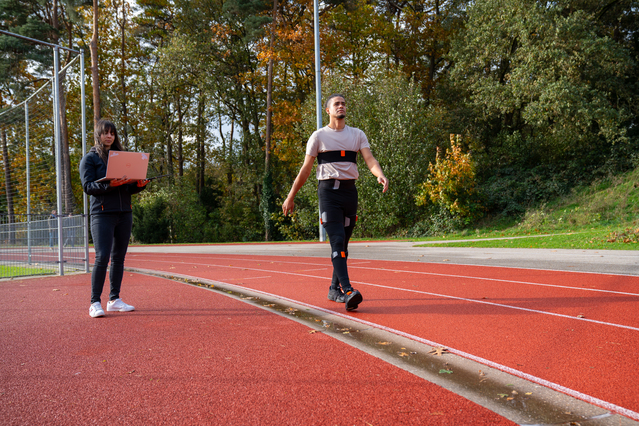
Wearable inertial motion capture records 3D movement in the lab, a clinic, a sports facility, or outdoors. The method stays consistent regardless of environment.
Motion data in gait research
Most gait research workflows share one core goal: quantify how the body moves during walking and produce metrics that can be compared across trials, conditions, and participants. Common outputs include:
-
Kinematics: joint angles, segment orientation, range of motion, velocity,
-
Spatiotemporal metrics: step length, cadence, step width, stride timing
-
Symmetry and coordination: left right differences, inter joint coordination
-
Task specific outcomes: trunk contribution, pelvic range of motion, movement variability
Three-dimensional motion analysis is necessary to compute these consistently. Full-body motion capture gives you the complete picture.
How is motion capture used in gait research?
A typical motion capture workflow for gait follows three stages:
1. Capture movement in 3D
Motion capture records segment motion over time and reconstructs a three-dimensional representation of how the body moves. Inertial systems use IMUs (inertial measurement units) to measure linear acceleration and angular velocity at each body segment. Wearable systems are especially practical when setup speed, portability, or the need to capture outside a fixed lab volume matter to the study design.
2. Convert signals into gait variables
Raw sensor data becomes meaningful through a biomechanical model and sensor fusion algorithm. The software estimates segment orientations and joint angles using anatomical modelling, then computes the kinematic and spatiotemporal outputs that map to the research question.
3. Visualize, quantify, and report
Movement analysis software is used to review movement in 3D, compute metrics and summary statistics, compare conditions or cohorts, and export outputs for further analysis. Most teams work with MATLAB, Python, or specialist biomechanics platforms downstream.
Why motion capture matters for gait research
Wearable inertial motion capture extends what is possible in gait research because it adds:
-
Repeatability: standardized protocols across sessions, operators, and sites
-
Real-world measurement: clinics, community settings, sports facilities, and outdoors
-
Time efficiency: faster setup and turnaround from capture to results
-
Full-body context: whole-body kinematics, not isolated joint measures
If your work spans multiple environments or populations, wearable motion capture helps maintain a consistent methodology without confining research to a single space.
Choosing a motion capture system for gait research
When comparing motion capture systems for gait work, focus on criteria that protect data quality and support the practical demands of the research protocol.
1. Accuracy and consistency
Look for independent peer-reviewed validation across walking speeds and populations, not manufacturer specifications alone.
2. Movement analysis software quality
It should support 3D visualisation, detailed kinematic outputs, and export formats that fit the team's existing toolchain.
3. Workflow fit
Assess setup time and portability. In clinical settings especially, participant time is limited and friction compounds across a study.
4. Validation and support
Systems with a peer-reviewed publication record and active research community make methodology easier to justify and cite.
Why Xsens is a strong choice for motion capture for gait research
Many gait research teams choose Xsens because it maps directly onto what most lab, clinical, and field-based study designs require.
-
Capture outside a fixed volume: works in outdoor terrain, clinical environments, and training setups
-
Full-body kinematics: joint angles, spatiotemporal metrics, segment kinematics, and symmetry in one session
-
Software integration: exports to AnyBody, OpenSim, C-Motion Visual3D, and MATLAB in C3D, BVH, and MVNX formats
- A model that keeps developing: ongoing refinement of the biomechanical model and sensor fusion algorithms
-
Research and validation resources: Xsens maintains a research and validation hub that helps teams find publications and reference validation work in their methods and discussion sections.
Learn more about Xsens motion capture options.
Xsens is among the most cited wearable motion capture systems in peer-reviewed biomechanics and gait literature. Joint angle accuracy for major lower limb joints during walking typically falls within 1 to 3 degrees compared to optical reference systems.
Integration Overview
Xsens connects with the tools that gait researchers already use.
| Tool | Role in gait research |
| AnyBody Technology | Musculoskeletal modelling: estimate joint forces and muscle loads from Xsens kinematic data |
| OpenSim | Open-source simulation widely used in academic gait and rehabilitation research |
| C-Motion Visual3D | Gait analysis software with event detection, cycle normalisation, and statistical reporting |
| Delsys EMG | Combine full-body kinematics with electromyography for neuromuscular gait studies |
| MATLAB and Python | Custom processing pipelines, statistical analysis, and machine learning workflows |
| BOB Biomechanics Bundle | Joint load estimation and ergonomic risk assessment from Xsens capture data |
Summary
Gait research depends on accurate 3D human movement data. With wearable inertial motion capture and the right analysis software, teams can run repeatable gait studies in more places, with more participants, and with clearer outputs.
Xsens supports this across the full workflow, from capture in the field through to export into the platforms where analysis and reporting happen. It is a practical, validated system for gait research in clinical, academic, and applied settings.
FAQ
How is motion capture used in gait research?
IMU sensors capture full-body 3D movement. A biomechanical model converts the data into joint angles and spatiotemporal variables. Researchers then visualise, analyse, and export results for statistical reporting.
What metrics does gait motion capture produce?
Joint angles, segment orientations, range of motion, step length, cadence, gait symmetry indices, and task-specific movement variables.
Can gait analysis be done outside a lab?
Yes. Xsens wearable systems work in hospital corridors, community walking routes, sports facilities, and outdoor terrain — without line-of-sight camera requirements.
How accurate is Xsens for gait analysis?
Agreement with optical reference systems is typically within 1 to 3 degrees for major lower limb joints during walking. Validation studies are available at xsens.com/support/research-validation.