The right setup determines your data quality and creative freedom.
Motion capture delivers high-quality movement data across animation, game development, film, human movement science, and humanoid robotics training.
Not every mocap system requires the same equipment. Your choice affects accuracy, setup time, cost, and where you can capture.
Here is what each method requires, and what that means in practice.
Equipment for optical motion capture
When people think of motion capture, they often picture the dotted suit.
Those dots are usually retro-reflective markers that bounce light back to high-speed cameras. Multiple cameras surround the capture space and record the performer from different angles. The system triangulates the markers to reconstruct movement in 3D.
The real investment goes far beyond the suit. It typically includes:
- Multiple high-speed cameras
- Lenses and tripods
- Dedicated lighting
- Storage systems
- Power supply and cabling
- A controlled studio environment
- High-performance computers
- Skilled technicians for setup and cleanup
Optical systems can deliver highly accurate data, especially in controlled environments. However, they require space, calibration, and technical expertise. For many teams, this makes optical capture a studio-bound solution with significant upfront and operational costs.
Equipment for AI motion capture
AI-based motion capture removes the need for a suit.Instead, video footage is processed by software trained on large movement datasets. The system detects body keypoints and reconstructs motion digitally.
Typical requirements include:
- One or more video cameras, even smartphones
- Tripods
- Adequate lighting
- AI processing software
Lower hardware costs make AI motion capture attractive for quick setups or budget-constrained projects.
However, reduced hardware complexity often shifts the workload elsewhere. AI systems can struggle with occlusion, fast motion, or complex interactions. This typically means additional cleanup work to refine the animation. Many teams rely on experienced animators or technicians to polish the results.
AI mocap can be effective for previs, rapid prototyping, or content where ultimate biomechanical precision is less critical.
Equipment for inertial motion capture
Inertial motion capture simplifies the physical setup compared to camera-based systems.
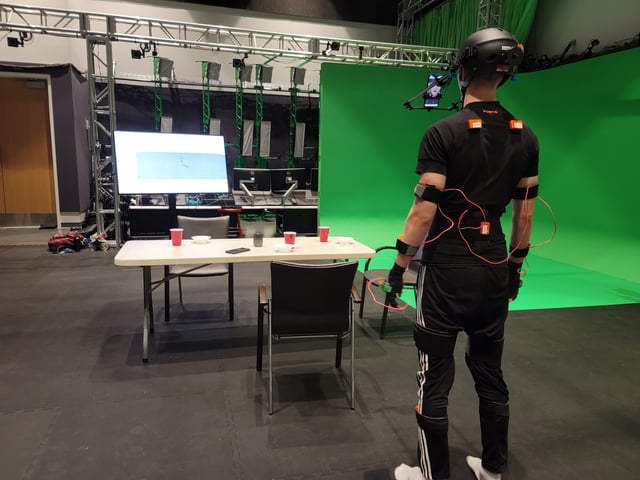
Instead of relying on external cameras, performers wear a suit equipped with trackers containing accelerometers, gyroscopes, and magnetometers. These sensors measure orientation, acceleration, and rotational velocity directly from the body.
The core setup typically includes:
- A motion capture suit with integrated sensors
- A computer for real-time processing
- Motion capture software
Because tracking happens on the body itself, there is no need for camera arrays or dedicated lighting setups. Capture is not restricted to a fixed studio space. Teams can record indoors or outdoors, on set, in a warehouse, or on location, including environments with limited lighting.
With Xsens inertial systems, motion data streams in real time to Xsens Animate software. Advanced sensor fusion algorithms and electromagnetic shielding help reduce interference from nearby electronics. The result is stable, high-quality data that requires minimal cleanup in many production workflows.
For professionals in game development, film production, virtual production, and robotics, this translates into faster setup, fewer environmental constraints, and consistent performance across different locations.
Combining technologies for advanced workflows
In some high-end productions, different motion capture methods are combined.
For example:
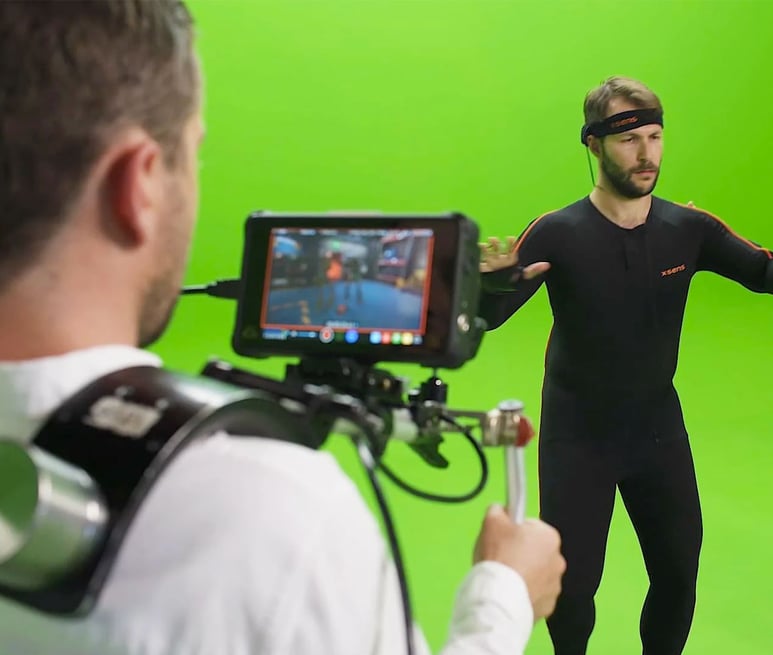
- Optical systems for large-volume multi-person tracking
- Inertial systems for precise joint angle data and mobility
- HTC Vive Mars for enhanced position aiding and object tracking
These hybrid workflows support complex shoots, virtual production stages, and large-scale interactive environments. They do require additional budget and coordination, but for demanding projects they offer extended flexibility.
Choosing the right equipment for your goals
There is no universal answer.
If you operate in a fixed studio with large teams and controlled conditions, optical systems may fit your needs.
If you need a lightweight entry point for quick content creation, AI-based systems can support early-stage work.
If you require accurate, portable, real-time motion capture without studio constraints, inertial systems provide a flexible alternative.
The right equipment depends on your production goals, environment, and required data quality.
Explore how Xsens motion capture supports professionals across games, film, virtual production, and robotics.
Discover Xsens motion capture technology.