Games are an escape. In free moments, players step into fantasy worlds, contested battlegrounds, or distant galaxies. Sometimes these worlds are entirely imagined. Sometimes they mirror real life. To pull players into these experiences, game developers design worlds that are either highly stylized or convincingly realistic.
Over the past decades, video games have evolved from simple pixel graphics to vast, explorable universes. This evolution has not only been driven by graphics and hardware, but also by how characters move. Believable motion plays a critical role in immersion, and this is where motion capture has become essential.
Dynamic character animation
Early games relied on static sprites and looping animation cycles. Today, players expect characters to walk, run, breathe, and react with subtlety. Small inconsistencies in posture or timing can feel unnatural, even if the player cannot explain why. This is often described as the uncanny valley.
Motion capture offers a more direct approach. Performers act out movement, sensors record that motion, and animators refine the data for use in game engines. Compared to frame-by-frame animation, this approach dramatically speeds up production while delivering more natural results.
AAA titles such as The Last of Us and God of War rely heavily on motion capture to give characters human weight and presence. The way a character shifts balance, turns their head, or pauses before speaking helps players connect emotionally and stay immersed in the story.
Motion capture is not limited to human characters. Fantastical creatures benefit just as much from real performance. Actors may use props or physical extensions to suggest tails, wings, or altered anatomy. Starting from real movement gives animators a grounded base that is far more convincing than building motion from scratch.
Authentic sport and combat sequences
For specialized movement, accuracy becomes even more important. Sports games are closely scrutinized by players who know exactly how a sprint, tackle, or jump should look. Even small errors can break immersion.
To solve this, studios often work with professional athletes. For example, FIFA 22 used inertial motion capture to record players moving naturally on the pitch. This approach captured realistic biomechanics, which were then translated into responsive in game animations.
Combat presents similar challenges. A character may transition from running to blocking to striking within seconds. Creating these sequences manually is time consuming and risks inconsistency. Capturing continuous performance from a single actor preserves posture, balance, and timing, making transitions feel fluid during gameplay and cinematics.
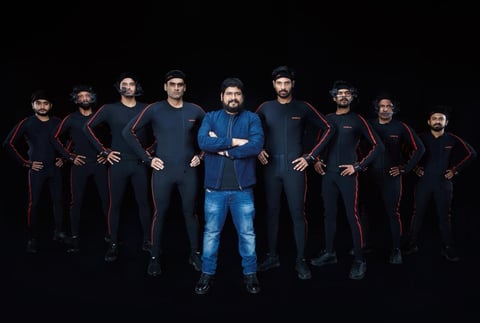
 Authentic football movement captured with Xsens motion capture for FIFA 22.
Cinematic cutscenes and trailers
Cutscenes are where games lean fully into storytelling. Player control pauses, and visual performance takes over. Every gesture, shift in weight, and subtle movement matters. These scenes function much like short films, where emotional credibility depends on performance detail.
Motion capture records these nuances. Hand movements, breathing patterns, and small hesitations all contribute to scenes that feel grounded rather than staged. This helps bridge the gap between gameplay and narrative moments.
Trailers face similar pressure. They must communicate tone, story, and gameplay within seconds. Using motion capture allows studios to move quickly from performance to polished visuals. With strong motion data from the start, animation teams can focus on refinement rather than rebuilding movement under tight deadlines.
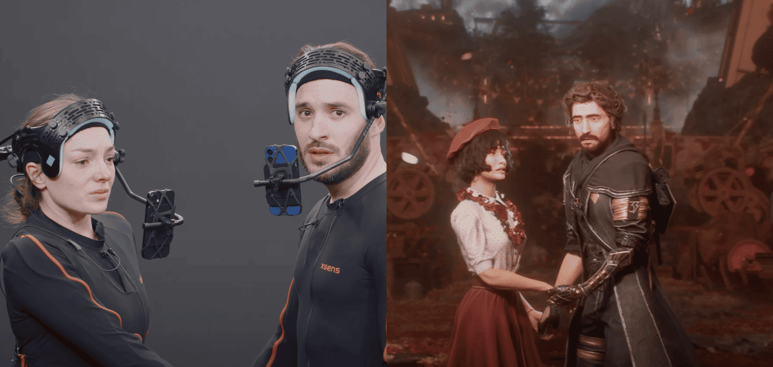 Stylized performances brought to life with Xsens motion capture in Clair Obscur Expedition 33.
Essential technology for modern games
Game studios vary widely in size, but they share common challenges. Production timelines are tight, player expectations are high, and tolerance for unnatural movement is low. Motion capture helps address all three.
By capturing performance directly, studios reduce animation time and costs. Animators spend less time correcting motion and more time shaping characters. Motion capture also creates consistency across gameplay, cutscenes, and marketing content.
Different approaches exist, including optical, inertial, and AI based solutions. Many studios choose optical or inertial systems for their reliable data quality and minimal cleanup. This allows animation to move quickly into the engine without extensive manual keyframing.
Inertial motion capture, in particular, has become increasingly popular in game development. Its camera-less setup, portability, and flexibility make it suitable for both large studios and smaller teams. Developers can capture motion in more locations, with fewer constraints, and integrate it directly into existing workflows.
Xsens and game development
Xsens has been supporting game developers for decades with inertial motion capture solutions designed for production realities. With portable hardware and professional-grade data quality, Xsens enables teams to capture motion anywhere, from studio floors to improvised spaces.
By reducing setup time and cleanup effort, Xsens helps developers focus on performance and storytelling. The result is believable character movement that scales across gameplay, cinematics, and marketing, without slowing production.
Explore how Xsens motion capture supports modern game development workflows.